Kerbside Custody: Closing the Final-Mile Security Gaps for Kent Businesses

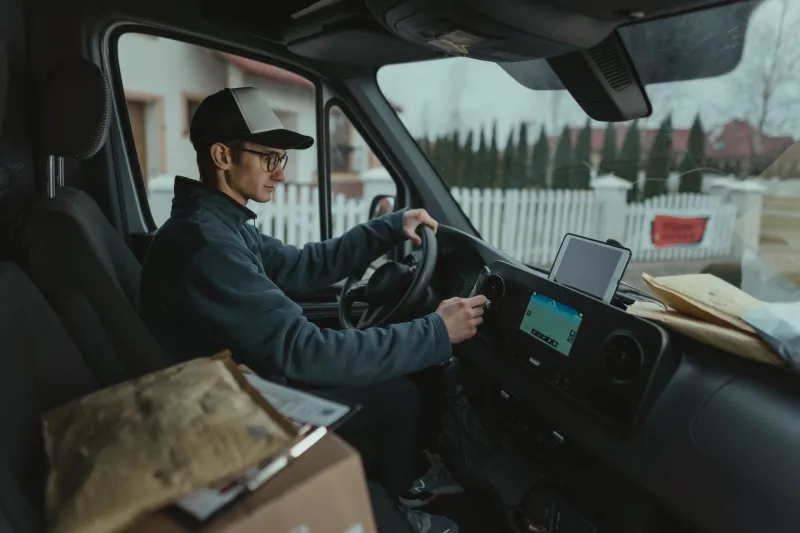
Photo: courier van parked on UK high street parcel handover security, via www.etonline.com
The risk has moved closer to the door
For many Kent businesses, the mental image of cargo theft still involves a locked industrial estate, a forced shutter or a lorry parked overnight on a motorway service area. Those risks remain. But the more common exposure in 2026 is quieter and closer to the customer: a courier van left running outside a shop, a parcel left in a communal hallway, or a handover completed without a clear record of who took possession.
The shift matters because Kent's delivery geography is dense and varied. A consignment may move from a depot near Dartford to a retail park in Maidstone, pause on an industrial estate in Ashford, cross the county via the M20, and finish at a residential address in Canterbury or Thanet. Each stage creates a short window in which responsibility for the goods is shared, ambiguous or simply assumed. Security is strongest when those windows are documented and narrowed.
Mapping the Kent delivery journey
Depot loading and vehicle presentation
The first risk point is often the least dramatic. Vehicles queuing at loading bays, doors open while paperwork is checked, and multiple collections booked into the same slot all create opportunity. In Kent, where many SMEs operate from compact units or shared estates, the loading area may also be visible from a public road. A van that is obviously full, with doors left open and no driver present, is a visible target.
Simple controls help: keep bay doors closed until the vehicle is ready, avoid leaving high-value consignments visible through windows, and ensure that loading is supervised even when the driver is known. For businesses using third-party couriers, ask how the carrier presents vehicles at collection and whether sealed or tamper-evident bags are used for smaller valuable items.
Mid-route stops and unattended vans
Kent's road network encourages multi-drop routes that mix urban and rural stops. A driver may leave a van for a few minutes in Sevenoaks, then park on a narrow lane near Tonbridge, then complete a handover at a business park in Medway. The risk is not the stop itself but the accumulation of unattended moments.
Businesses should not assume that every courier follows the same routine. A short checklist can be built into the contract or service review: Are vehicles locked and alarmed at every stop? Are keys removed? Are parcels left in a secure area rather than on a seat? Is the route planned so that high-value items are not left until the final drop? These questions are particularly relevant for same-day and dedicated vehicle services, where the consignment may spend longer in the vehicle than on a standard overnight network.
The doorstep handover and proof of delivery
The final handover is where security and customer service meet. A proof of delivery that records only a scribbled signature or a first name is weak evidence if a consignment later goes missing. A photograph of a parcel on a doorstep may prove delivery to an address, but not necessarily to the right person. For Kent retailers and manufacturers sending high-value or business-critical items, the handover should be treated as a custody transfer, not a formality.
Where possible, agree in advance what constitutes acceptable proof: a named recipient, a time stamp, a location, and a signature or photograph that matches the delivery instruction. For business addresses, specify whether goods may be left with a receptionist, security desk or named colleague. For residential addresses, be cautious about instructions that leave goods unattended in communal areas or visible porches.
A practical security checklist for Kent SMEs
- Confirm who is collecting and who is receiving, including the courier company, driver name and vehicle registration where available.
- Record consignment values and descriptions before collection, not after a problem arises.
- Use tamper-evident packaging or seals for high-value items and note the seal number on paperwork.
- Avoid leaving loaded vehicles unattended for long periods, especially on public roads or shared estates.
- Require locked vehicles and removed keys at every stop, not just overnight.
- Agree delivery instructions that are realistic for the address, including safe places and named recipients.
- Keep photographs of packaging and labels before dispatch where the value justifies it.
- Retain proof-of-delivery records, tracking histories and any correspondence in one place.
- Review recurring losses or near misses by route, depot and delivery type.
- Include security expectations in courier service reviews rather than treating them as the carrier's concern alone.
Documents that support a claim
Insurance documentation is more persuasive when it tells a coherent story. A claim is easier to progress when the business can show the consignment value, the collection record, the carrier's tracking trail, the delivery instruction and the proof of delivery. Photographs of the packed item and the label can help. So can evidence of the commercial relationship, such as the order confirmation or invoice.
Kent businesses should check that their cover reflects the way they actually send goods. A standard parcel might be covered under one arrangement, while high-value components, samples or retail stock may need separate cover or a declared value. The time to discover a gap is not after a van has left a loading bay in Dover or a parcel has disappeared from a reception desk in Bromley.
Driver verification without delay
Verification does not need to become a lengthy gatekeeping exercise. For regular carriers, confirm that drivers are known to the depot and that subcontractors are subject to the same checks. For ad hoc or same-day services, ask for the driver's name and vehicle details in advance and match them at collection. A photo ID check at the depots that handle high-value goods is reasonable, provided it is applied consistently and does not hold up scheduled collections.
The aim is not to treat every courier as a suspect. It is to create a record that distinguishes normal practice from an anomaly. If a vehicle arrives without the expected markings, or a driver cannot confirm the consignment reference, that is useful information before the goods leave the premises.
Habits that cost little and protect more
Security improvements often fail when they depend on extra staff or lengthy procedures. The more durable habits are small: keep loading areas tidy and closed, avoid advertising what is inside a vehicle, use consistent handover language, and review incidents monthly. For Kent SMEs sending regular consignments, a short security section in the courier agreement can clarify expectations without slowing down the collection.
Cargo theft at the kerbside is not solved by a single measure. It is reduced by closing small gaps in custody, evidence and routine. In 2026, the businesses that manage that well will not necessarily have the most elaborate security systems. They will be the ones that know where their goods are, who has accepted them, and what proof exists if the chain breaks.