The Collection Point Calculus: Out-of-Home Delivery Options for Kent Retailers in 2026
Out-of-home delivery has moved steadily from the margins of UK e-commerce towards the mainstream. For Kent businesses, the appeal is easy to understand: fewer failed deliveries, lower last-mile costs and a customer journey that does not depend on someone being at home during a working day. Yet the decision to add lockers, collection counters or click-and-collect is not simply a matter of switching on a new option in a courier account. It requires a realistic assessment of where customers are, what they are buying and how much operational complexity the business can absorb.
Why out-of-home delivery is gaining ground in Kent
The county presents a useful test case for the out-of-home model. Kent has dense urban corridors around Dartford, Gravesend, Maidstone and Ashford, alongside market towns such as Sevenoaks, Tonbridge and Faversham, and rural areas stretching across the Weald and Romney Marsh. In the towns, parcel lockers and staffed collection points can fit naturally into existing retail and transport patterns. In more dispersed areas, coverage is thinner and the customer journey can be less predictable.
For retailers, the strongest argument is often failed-delivery reduction. A parcel that is left with a neighbour, returned to a depot or redelivered carries a cost that is not always visible on the initial shipping label. Out-of-home options can move the point of handover to a location and time that suits the customer, reducing the risk of a wasted van stop. For SMEs dispatching from a unit in, say, Aylesford or Sittingbourne, that can mean fewer customer service enquiries and a more reliable delivery promise.
The cost case is not always straightforward
On paper, out-of-home delivery can look cheaper. Carriers may offer lower rates for locker and counter deliveries because they consolidate drops and avoid repeated attempts. However, the saving needs to be assessed against the full picture. There may be integration costs, additional labelling requirements, customer communication demands and, in some cases, a higher rate of abandoned baskets if the checkout experience becomes confusing.
The more useful question is not whether out-of-home is cheaper in isolation, but whether it is cheaper for the consignments a business actually sends. A retailer shipping low-value, low-risk items may find that a standard home delivery service remains the simplest option. A business sending higher-value goods, or operating in a sector where customers are often unavailable during the day, may find that a collection point improves both conversion and completion. The calculation should include the cost of failed deliveries, customer contact time and replacement shipments, not just the headline carrier rate.
Lockers, counters and click-and-collect are not interchangeable
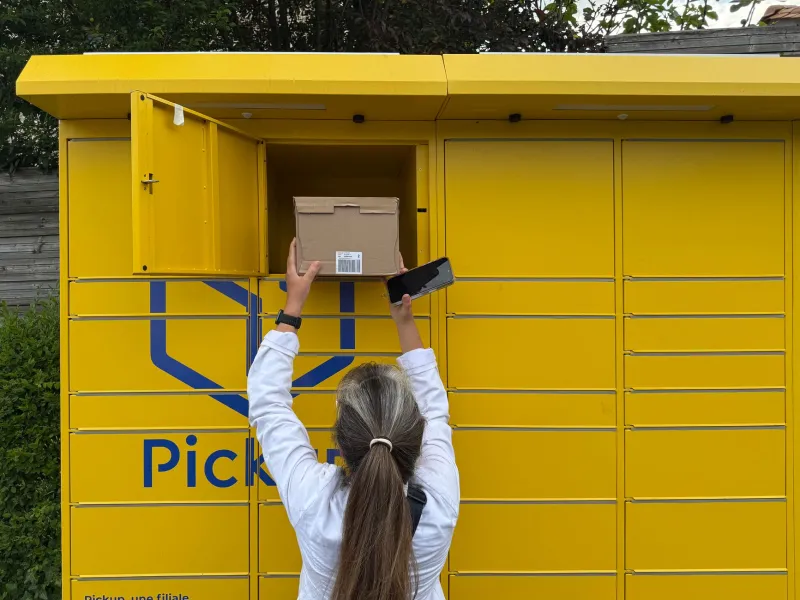
It is tempting to treat all out-of-home options as one category. In practice, they serve different purposes. Automated parcel lockers suit customers who want a quick, contact-free collection at a convenient time, often near a supermarket, station or retail park. Staffed counters in convenience stores and independent shops can offer a more personal handover and may be better for customers who are less comfortable with app-based collection. Click-and-collect, where the retailer itself provides the collection point, offers the greatest control over the customer experience but also places more demand on staff and premises.
For a Kent retailer with a shop in Canterbury or Tunbridge Wells, click-and-collect can strengthen the link between online browsing and physical footfall. For an online-only SME in Ashford, a carrier locker network may be more practical than attempting to run a collection counter. The right mix depends on the product, the customer base and the capacity of the business to manage each option well.
Rural coverage remains the sticking point
Kent's rural geography is a genuine constraint. A locker network that works well in Maidstone may offer limited value to a customer near Lydd or in the outer reaches of the Weald. Retailers should avoid assuming that a carrier's national network translates into convenient local coverage. It is worth mapping the postcodes of actual customers against the collection points available before promoting out-of-home delivery widely.
Where coverage is thin, a hybrid approach may be more honest. Offering collection points as an option rather than a default, and being clear about the nearest alternative, can prevent frustration. For some rural customers, a reliable home delivery window or a local shop counter may remain more useful than a locker several miles away.
Communication is part of the delivery service
Out-of-home delivery only works if the customer understands what is expected. That means clear checkout wording, timely notifications and straightforward instructions for collection. A customer who selects a locker but does not receive a collection code promptly, or who arrives at a shop counter that is closed, will not regard the option as convenient. Kent retailers should test the full journey from basket to collection, including the emails and text messages that sit between dispatch and handover.
It is also important to set expectations around returns. If a customer collects from a locker but needs to return an item, the reverse journey should be equally clear. Out-of-home delivery can reduce friction on the outbound leg while creating new questions on the return leg if the process is not designed alongside it.
Integrating out-of-home into an existing courier setup
Operationally, the transition is rarely dramatic, but it does require discipline. Retailers should review label formats, carrier account settings, warehouse picking workflows and customer service scripts. Staff need to know which services are available, which postcodes are excluded and how to handle enquiries when a collection point is full or temporarily unavailable. For SMEs with a small team, a phased rollout is often more manageable than a wholesale change.
A sensible starting point is to offer out-of-home delivery on a limited product range or to a defined customer segment, then measure the results. Relevant measures include selection rates, failed-delivery rates, customer enquiries, average delivery cost and repeat purchase behaviour. This evidence is more useful than a general impression that lockers are popular.
A practical conclusion for Kent SMEs
Out-of-home delivery is neither a cure-all nor a passing trend. For many Kent businesses it offers a credible way to improve convenience and reduce wasted delivery attempts, particularly where customers are difficult to reach at home. But the benefits depend on local coverage, clear communication and a courier setup that can support the option without creating new administrative burdens.
The most effective approach in 2026 is likely to be selective. Retailers should treat lockers, counters and click-and-collect as distinct services, assess them against their own consignment profile and customer map, and introduce them where they solve a real problem. Used in that way, out-of-home delivery can be a useful addition to a Kent retailer's delivery mix rather than another layer of complexity.