Two Wheels or Four? When Cargo Bikes Genuinely Beat Vans in Kent's Town Centres
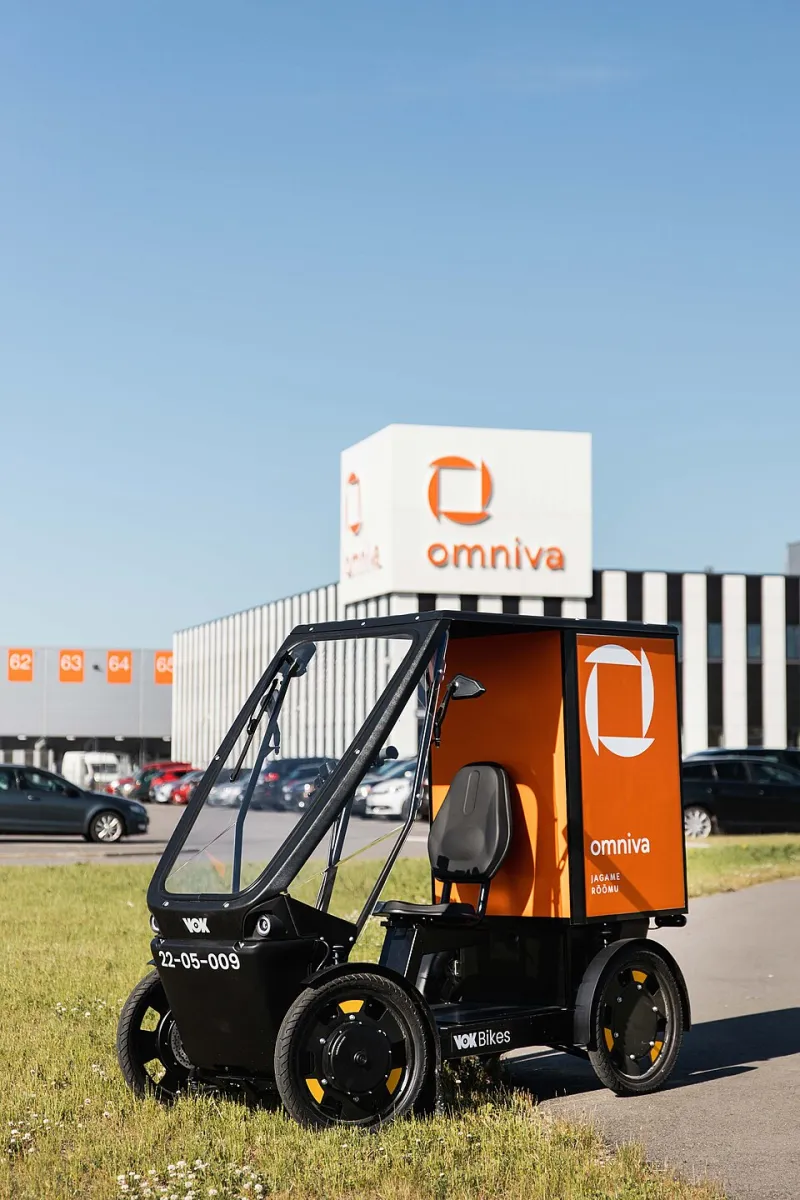
Photo: Unknown authorUnknown author, CC BY-SA 4.0, via Wikimedia Commons
The pitch for cargo bikes is easy to make and easy to oversell. A loaded e-cargo bike slips through a pedestrianised high street, parks at the door, costs a fraction of a van to run and photographs beautifully for the sustainability section of a website. What the pitch omits is that the same bike, on a wet Tuesday in February, with a 90kg consignment and a customer expecting a two-hour window, is a considerably less elegant proposition.
For Kent businesses weighing the choice, the useful question is not whether cargo bikes are good. It is which specific drops, in which specific towns, at which specific times of year, they genuinely handle better than a van.
The premise: town-centre drops are parking problems
Most of the friction in a Kent town-centre delivery has nothing to do with distance. It is the last 200 metres: the bay that is occupied, the double yellow line outside the only accessible entrance, the loading restriction that runs from 10:00 to 16:00, the barrier at the Westgate Towers, the width restriction on a medieval lane in Canterbury, the one-way system that turns a three-minute drop into a twelve-minute loop in Maidstone.
A van solves the journey and loses the arrival. A cargo bike is a tool for the arrival. That is the correct framing, and it explains why the bike tends to work best in dense, flat, short-hop environments and struggles elsewhere.
Decision point one: payload and parcel shape
A typical four-wheel or two-wheel e-cargo bike carries somewhere between 60kg and 100kg of payload in a box of roughly half to one cubic metre. That is plenty for a morning of pharmacy orders, documents, small parcels, bakery trays or parts. It is nowhere near enough for furniture, white goods, bulky flat-pack or a palletised consignment.
Volume often binds before weight. A box of lightweight but awkward items — long tubes, flat picture frames, rolled signage — can fill the cargo box at 30kg and leave you making two trips where one van would have done.
Rule of thumb: if the consignment fits in a car boot and weighs under 60kg, the bike is viable. If it needs two people to lift or a tail-lift to lower, it is not.
Decision point two: terrain and town geometry
Kent's towns are not interchangeable, and the difference is measurable.
Canterbury rewards the bike strongly. The city centre is compact, the pedestrianised core is wide, and the approach roads are short. The Westgate Towers width restriction and the medieval street pattern are precisely the obstacles a cycle-width vehicle removes. Historic cobbled sections in the Butchery Lane and Mercery Lane area are passable, if uncomfortable, at reduced speed.
Maidstone is mixed. The High Street and the riverside quarter suit the bike, but the gyratory and the spread of the retail and business parks along the A229 and A20 do not. A bike serving a town-centre cluster works; a bike doing a ring around the industrial estates does not.
Tunbridge Wells is the hardest of the three. The gradient between the Pantiles, the town centre and Mount Pleasant is punishing on a loaded bike, and the road network funnels traffic through a small number of steep junctions. Short flat hops around the Calverley Road area are fine; a route climbing to the higher streets with 80kg aboard is a trial of both rider and battery.
Elsewhere the pattern holds: Ashford's pedestrianised High Street is bike-friendly, Dover and Folkestone town centres are workable on the flat, and anything rural is van territory by default.
Decision point three: weather and season
This is where the enthusiasm usually meets reality. A rider in steady November rain covers ground more slowly, takes more shelter, and delivers a parcel with a visibly damp exterior, which customers notice even when the contents are fine. High wind is a genuine handling issue with a loaded box, and ice removes the bike from service entirely on the days when a van is at its most useful.
A realistic planning assumption for a Kent cargo-bike operation is that bikes handle the clear majority of spring and summer working days and a reduced share of the winter months. If your service promise depends on bike capacity in December, you need van fallback built into the contract, not improvised on the morning.
Decision point four: cost per drop
The comparison is frequently drawn badly, using purchase price against purchase price. The meaningful figure is cost per completed drop in a specific town centre.
On the bike side, the recurring costs are the rider's hour, the bike's lease or depreciation, insurance, battery and maintenance. On the van side, add fuel, the lease, insurance, and then the items that town-centre work makes unavoidable: parking charges, penalty notices, and the driver's time spent circling.
In dense centres where a rider can complete eight to twelve drops in an hour because the bike parks at the door, the bike frequently wins. In dispersed locations where the same rider manages three drops an hour, the van's larger capacity usually outweighs its friction. The crossover tends to appear somewhere around five or six drops per hour at a density of more than fifteen drops per square mile. Below that, the van is usually cheaper once the full cost of the bike's limited capacity is counted.
Decision point five: customer expectation
Some customers care how the parcel arrives; most care when. Cargo bikes can offer tighter, more predictable windows in town centres, which is a genuine commercial advantage. Proof of delivery, photographic evidence and live tracking are all available on bike operations and increasingly expected.
What bikes handle less gracefully is the consignment that needs a hand to the door, an unpack, a signature from a named individual who is not at the front desk, or a collection taken in exchange. On a bike, the rider is the whole operation, and every additional minute is a minute off the round.
Where the bike loses, plainly
- Consignments above roughly 60kg or with awkward dimensions.
- Rural routes and business parks outside the ring road.
- Cross-Thames work, where distance and the Dartford Crossing make the bike irrelevant.
- High-value goods where the rider cannot leave the bike unattended.
- Ice, heavy wind and the busiest week of Peak Season.
- Anything requiring two-person handling.
A hybrid that most SMEs land on
The workable pattern in Kent is rarely a wholesale switch. It is a split round: a van runs the out-of-town and bulky work, while a cargo bike covers the town-centre cluster, releasing the van from the parking bays it was never going to find. Both vehicles meet at a fixed point once mid-morning to swap consignments.
That arrangement keeps the capacity where capacity is needed and the agility where agility pays. The decision, in the end, is not pedal power or white van. It is which parcels belong to which, and whether your operation is disciplined enough to sort them before the round begins rather than at the bay door.